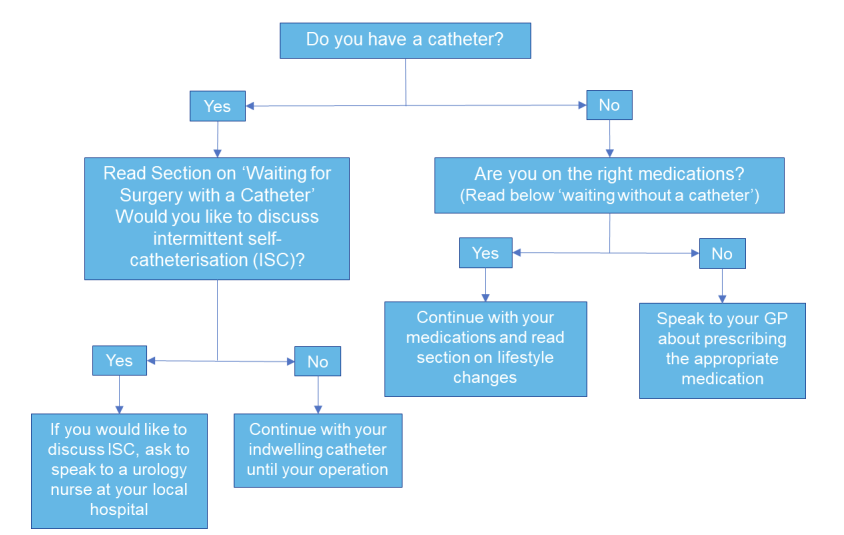
How to manage your condition whilst you are waiting for treatment
If you feel that your condition is deteriorating, and that you may no longer be able to have an operation, then please contact your hospital urology team. You can look on any appointment letters you have from your hospital for this information.
If you experience any of the following complications, it is important that you call 111 or speak to your GP practice urgently.
- Urinary tract infection (UTI) Due to urine in the bladder not emptying properly, it is common to get infections in the urine. Symptoms of a UTI are pain in the lower abdomen, stinging when passing urine, suddenly having to pass urine more frequently, fevers and feeling unwell.
- Acute urinary retention This is a sudden painful inability to empty your bladder. Symptoms of this include lower abdominal pain or penile tip pain and are unable to pass urine.
- Chronic urinary retention This is caused by the volume of urine left behind after urination gradually increasing. You may notice a firm swelling in the middle of your lower abdomen tummy), wetting the bed at night can happen, and also needing to urinate more often.
If you experience the following, please call 111 or speak to your GP practice.
- Haematuria Some patients with enlarged prostates will get visible blood in their urine. This is called haematuria. Sometimes there can be blood in the urine where a catheter is in place.
Waiting for surgery with a catheter
A catheter is a soft tube that goes into your bladder through your urethra and holds open your prostrate to allow urine to pass. A catheter empties your bladder and helps prevent the build-up of your urine.